Print the PDF
What Can I Do If I Disagree with the IEP Team?
Conflict Resolution Options in Special Education
Parents have many rights in special education. One of these rights is to disagree with the other members of the Individualized Education Program (IEP) team and to share their concerns about the help and services their child is receiving.
Parents have different ways, both formal and informal, to solve concerns about their child’s IEP. Informal problem-solving through routine conversation helps promote IEP team partnership and collaboration.
The Iowa Procedural Safeguards Manual details parents’ and guardians’ rights to legal action under the Individuals with Disabilities Education Act (IDEA). This can be found through the Iowa Department of Education’s website, or you can request a copy from your IEP team.
How can I build a good partnership?
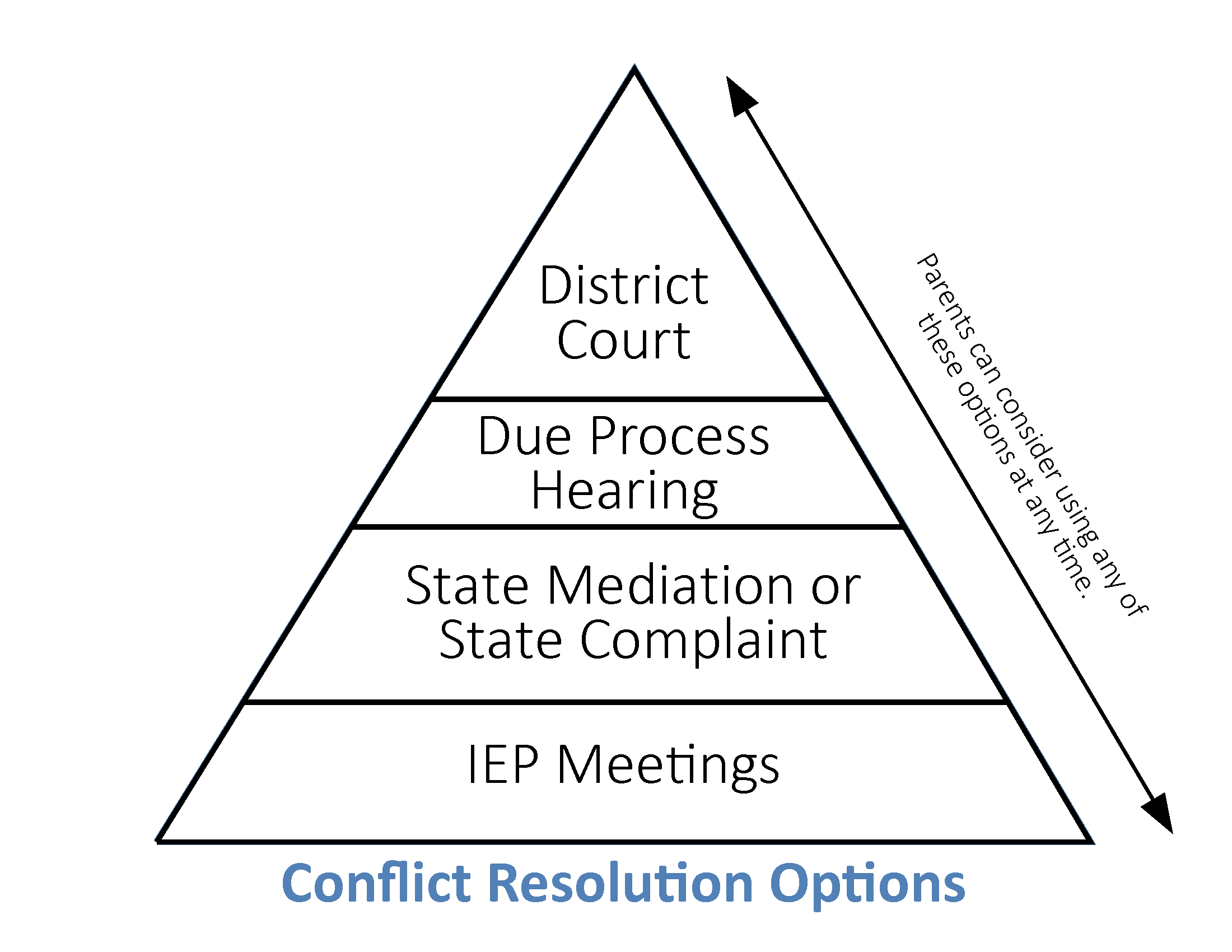
Successful conflict resolution needs everyone’s effort to be part of the solution. Parents can consider using any of these options at any time. If higher-level actions are taken first, it may be difficult to move to lower levels.
The most effective way to prevent conflict is to establish good partnerships. This is done through communication, relationships, and collaboration. Positive relationships between families and educators develop with regular contact before there is a problem. By keeping in touch before problems arise, it becomes easier to work together when challenges do come up.
The way you choose to communicate could have an impact on how your message is received. To support good partnerships:
• Try to avoid micromanaging, but also make sure to address any small concerns as they come up so they don’t grow into bigger issues later on.
• Small problems can be quickly shared with a short phone call or an email. However, this may not be the best for important messages.
• If there is a problem causing disagreement, create a written record, like a letter or an email, to send to the teacher, principal, or another team member. Consider sending this to more than one person.
• If you expect a written reply, ask for it in your letter or email.
• Make sure your messages are clear and focus on the main problem or request about your student.
• When a problem or difference of opinion happens, parents may request a problem-solving meeting.
• A quick meeting with the teacher can often solve a small issue. However, if the team needs to talk about changes to the IEP, the team should have a meeting.
How can the IEP process help resolve disagreements?
Requesting an IEP meeting can be one of the best ways to solve disagreements before considering higher levels of conflict resolution.
The IEP team should always include the right people to help make decisions. There are different things that might affect how decisions are made, but the team should always focus on the student’s needs and available data. Parents or teachers can suggest changes to the IEP that they believe will help the student. Families can also share important information from other professionals, which must be considered by the team.
If the team is unable to agree, parents can ask for a Prior Written Notice (PWN) of the proposed or refused action. The PWN states the reason for the school’s decision. Parents may challenge or appeal a decision by using their conflict resolution options.
What is State Mediation?
State Mediation is a meeting where families and school or AEA officials come together to talk about differences they might have. A trained person, called a mediator, from the Iowa Department of Education (IDOE) helps everyone understand the problem, guides conversations, and helps to find an agreement that is acceptable to all. Parents should be ready with specific requests about their child’s IEP and any information that supports those requests. It’s also important to be open to negotiations that will benefit their student.
Families and schools can choose to have a lawyer represent them during the mediation session if they want to. It is common for the school and AEA to have a lawyer to represent them during the mediation session.
What is a State Complaint?
A State Complaint can be filed with the IDOE if someone believes that the school district or AEA has violated a Special Education state rule or law under IDEA. This includes violations of a child’s IEP. The complaint must be completed within one year of the alleged violation. It should identify the impact that the violation had on the student’s education.
In this process, the IDOE will finish a fact-finding investigation and a written decision within 60 days of receiving a complaint. If the investigation finds that rules were broken, a corrective action plan will be issued.
What is a Due Process Hearing?
A due process hearing is a legal proceeding. Both parents and school officials present their case to an Administrative Law Judge (ALJ) designated by the IDOE. It is a much more formal process than mediation. School districts and/or the AEA are represented by their own attorney. Parents can choose to be represented by an attorney and are responsible for the costs. Under IDEA, parents can be awarded some of the money they spent on legal fees if they win their case against the school districts or AEAs. However, getting this money back is not guaranteed.
It is important for families to understand the financial costs, as well as the possible relationship damage caused by a due process hearing. It has been said that mediation is like marriage counseling, and a due process is like divorce.
What is District Court Action?
If parents, school districts, or AEAs do not agree with a decision made by the ALJ in a due process case or a complaint decision from the IDOE, they can appeal the decision in the district court. Under IDEA, parents can be awarded some of the money they spent on legal fees if they win their case against the school districts or AEAs.
Focus on Students and Solutions
It’s important to have a good working relationship with your school district and AEA staff to help your child succeed in school. Focus on your student and their needs. There are many options for parents, but solving disagreements at the lowest level can lead to better long-term benefits.
Related Resources
Look for the following resources on the ASK website:
• Parent Guide to Educational Advocacy
• Communication Matters
• We Still Disagree– What is the Next Step?
• Prior Written Notice
Look for the following resources on educateiowa.gov:
• Procedural Safeguards Manual: Rights of Parents of Students with Disabilities
• Dispute Resolution
ASK Essential Questions
• Have I put my concerns in writing?
• Do I have a Prior Written Notice from the school explaining the school’s reason for a decision that has been made?
• Should I consider getting legal representation?